Nonprofit Financial Hub
Operating Grants vs. Nonprofit Loans: How to Choose the Right Funding for Your Mission
Strong missions need strong foundations. Programs may inspire headlines, but rent, payroll, software licenses, and utility bills keep the lights on. Yet many nonprofit leaders spend so much time chasing restricted program grants that they overlook two critical questions: How will we cover day-to-day operations? and What happens when funding doesn’t arrive on time?
Operating support grants are one answer. They fund general expenses and provide flexibility that restricted grants can’t match. But here’s the reality: grant funding is competitive, timelines are unpredictable, and even awarded grants can take months to land in your account. That’s exactly where nonprofit financing fills the gap.
This guide breaks down everything nonprofit leaders need to know about operating grants, compares them with financing alternatives like lines of credit and bridge loans, and explains how to build a funding strategy that keeps your organization stable, resilient, and focused on impact.
What Are Operating Support Grants?
Operating support grants (sometimes called general operating support or unrestricted grants) are funds awarded to nonprofits for everyday expenses. Unlike program-specific grants that dictate exactly how each dollar must be spent, operating grants give organizations the freedom to allocate money where it’s most needed.
Typical expenses covered by operating support grants include:
- Staff salaries, benefits, and payroll taxes
- Office rent and facility costs
- Utilities, insurance, and software subscriptions
- Professional development and board training
- Strategic planning, financial auditing, and capacity building
- Marketing, outreach, and community engagement
These grants are popular because they address the operational backbone of a nonprofit. When an organization secures operating funding, it can plan with confidence, invest in growth, and stop scrambling to cover basic overhead.
Why Operating Grants Are Hard to Win
Despite their value, operating support grants represent a small fraction of total philanthropic giving. Most foundations prefer to fund specific, measurable programs. That creates an imbalance: nonprofits have plenty of options for program grants but far fewer opportunities for the unrestricted funding thatactually keeps organizations running.
Here are some of the biggest challenges:
- Intense competition: Hundreds of organizations apply for the same operating grants, and approval rates are low.
- Strict eligibility requirements: Many grants restrict applications by geography, mission type, organizational age, or budget size.
- Lengthy timelines: From research and application to review and disbursement, the process can take six months to a year or longer.
- Unpredictable outcomes: Even strong applications get rejected. Building a budget around uncertain grant revenue is risky.
- Reporting and compliance burden: Grant recipients often need to produce detailed impact reports and financial documentation after funding is received.
None of this means you should stop pursuing grants. Operating grants are valuable, and every nonprofit should include them in its funding strategy. But relying solely on grants to cover operational costs puts your organization at risk every time a funder says no or a payment is delayed.
The Funding Gap That Grants Can’t Always Fill
Consider this scenario: A mid-sized human services nonprofit receives a $250,000 operating grant in Ja nuary. The organization plans its annual budget around that award. But the grant check doesn’t arrive until April. Meanwhile, payroll is due every two weeks. The landlord expects rent on the first of the month. Vendors need to be paid.
This is the funding gap that cripples even well-managed nonprofits. The money is coming, but it’s not here yet. And in that gap, organizations are forced to delay programs, defer vendor payments, or dip into restricted program funds (which creates compliance problems).
Flexible nonprofit financing exists precisely for these situations. A nonprofit line of credit or a bridge loan can cover expenses during the waiting period and get repaid once the grant arrives. It’s not an either/or decision between grants and loans. Smart nonprofits use both.
Operating Grants vs. Nonprofit Loans: A Side-by-Side Comparison
Understanding the differences between grants and financing helps nonprofit leaders make informed decisions. Here’s how the two options compare:
| Factor | Operating Grants | Nonprofit Loans |
|---|---|---|
| Cost | Free (no repayment) | Interest and fees apply |
| Speed of access | Months to a year+ | Approvals in as little as 14 business days from receipt of a complete application. |
| Certainty | Uncertain; competitive | Predictable once approved |
| Flexibility of use | Flexible (if unrestricted) | Flexible; broad use cases |
| Availability | Limited opportunities | Available year-round |
| Reporting requirements | Often required | Usually Minimal post-funding |
| Best for | Long-term sustainability | Immediate capital needs |
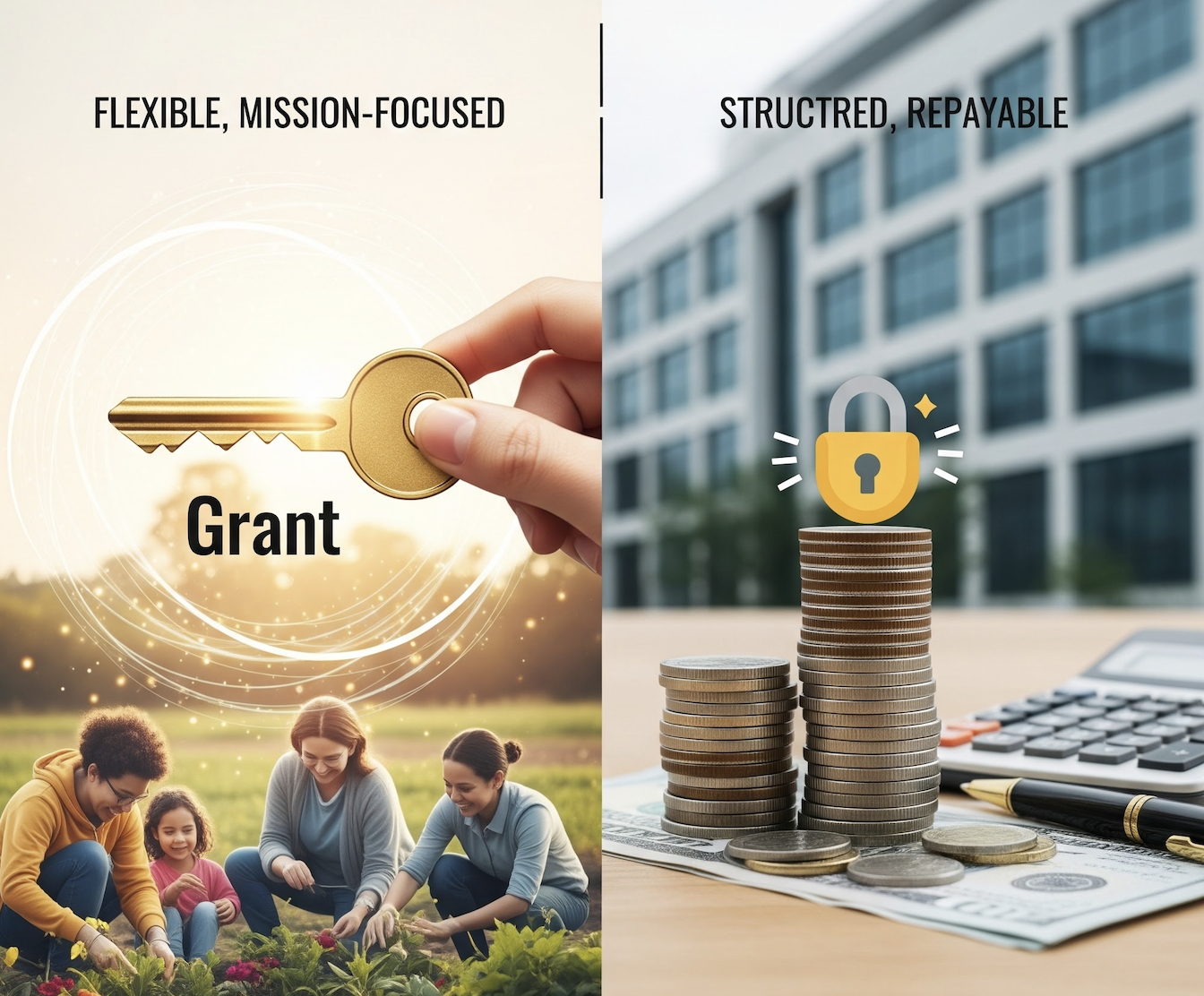
The takeaway? Grants and loans serve different purposes. Grants reduce your cost of capital over the long term. Loans give you speed and certainty when timing matters. The strongest nonprofits combine both.
Types of Nonprofit Financing That Support Operations
If your organization has ever delayed a program, missed a payroll deadline, or turned down a growth opportunity because cash wasn’t available, these financing options are worth understanding. At B Generous, we connect nonprofits to lenders who specialize in mission-driven organizations, offering loans from $25,000 to $100 million.
Nonprofit Lines of Credit
A nonprofit line of credit is pre-approved, revolving funding you can draw from whenever you need it. You only pay interest on what you use. When you repay, the credit becomes available again.
This is especially useful for:
- Smoothing over seasonal revenue fluctuations
- Covering payroll when grant disbursements are delayed
- Pre-paying event expenses before sponsorship income arrives
- Handling unexpected costs without disrupting programs
Think of it as a financial safety net that’s always there when you need it, but costs nothing when you don’t.
Bridge Loans for Nonprofits
When your organization has confirmed funding on the way but needs cash now, a bridge loan fills the gap. These short-term loans (typically 6 months to 2 years) provide immediate capital that gets repaid once your expected funds arrive.
Common use cases include:
- Waiting on government grant reimbursements or contracts
- Covering costs while a capital campaign wraps up
- Managing timing gaps between pledged donations and actual cash received
- Keeping capital projects on schedule despite delayed disbursements
Pre-Development Financing
Before a major construction or renovation project begins, there’s significant groundwork: environmental studies, architectural planning, permits, legal reviews, and site preparation. Pre-development loans cover these early-stage costs so your project can move forward without waiting for full construction capital.
This financing is critical for nonprofits planning new facilities, campus expansions, or community development projects. Without it, promising projects can stall for months or even years at the planning stage.
Charter School Financing
Charter schools face unique financial pressures. Per-pupil funding arrives on government timelines, but lease payments, teacher salaries, and classroom supplies don’t wait. Charter school financing supports expansions, new campuses, staffing needs, and operational expenses during the gaps between enrollment counts and funding disbursements.
Growth-stage charter schools especially benefit, since they’re often scaling enrollment faster than their state funding can keep up with.
Hospital Loans for Nonprofit Healthcare
Nonprofit hospitals routinely deal with slow insurance reimbursements, rising operating costs, and aging equipment that needs replacement. Hospital loans provide working capital, equipment financing, and bridge funding so patient care continues without interruption.
Loan amounts for hospitals can range from $100,000 to $100 million, depending on the facility’s financial capacity and project scope.
Faith-Based Organization Loans
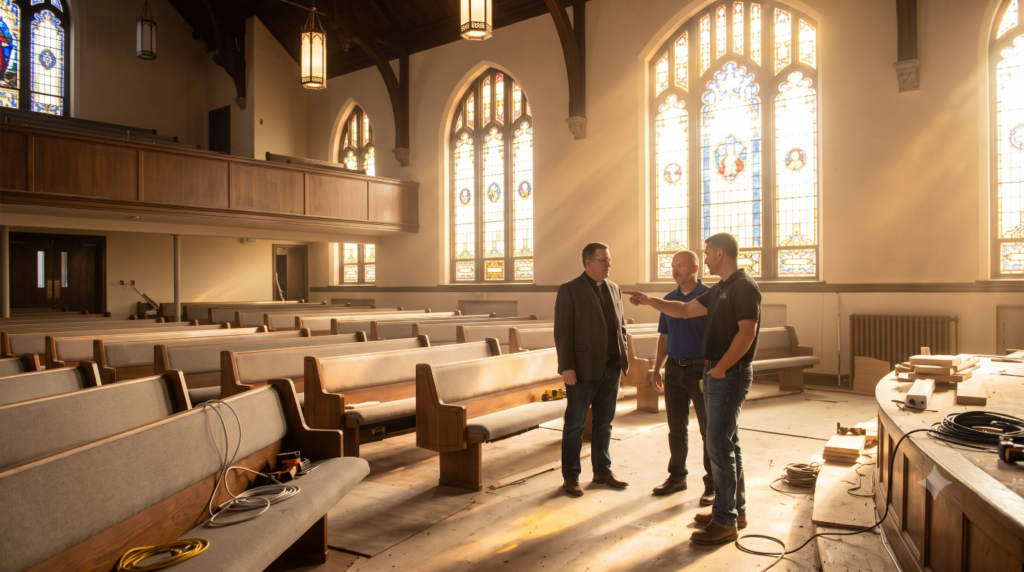
Churches, synagogues, mosques, and other religious organizations don’t always fit neatly into traditional lending criteria. Their revenue comes from donations, tithes, and community support rather than earned income. Faith-based loans are structured with these realities in mind, supporting facility expansions, program launches, and operational needs while respecting the organization’s mission and values.
When to Pursue Grants and When to Consider Financing
Both funding strategies have their place. Here’s a framework for deciding which to prioritize based on your current situation:
Pursue operating grants when:
- Your organization has the time and staff capacity to research, write, and manage grant applications
- You’re building long-term financial sustainability and want to reduce borrowing costs
- You meet the eligibility criteria for specific operating support programs
- Your funding need isn’t time-sensitive (you can wait several months for a decision)
Consider nonprofit financing when:
- You need capital now, not in six months
- An awarded grant is delayed but expenses can’t wait
- You’re preparing for a construction or expansion project with upfront costs
- Cash flow is seasonal and you need a buffer during slow periods
- You want to seize a time-limited opportunity (new facility, equipment deal, matching gift)
The most financially resilient nonprofits treat grants and loans as complementary tools, not competing ones.
How to Strengthen Your Grant Applications
While this guide emphasizes the importance of financing as a complementary strategy, we want to help you win more grants too. Here are practical tips to improve your operating grant applications:
- Lead with your impact story, not your financial need.Funders want to invest in outcomes. Show how operating support enables the programs and results they care about.
- Demonstrate organizational health.Present clean financials, a diverse revenue mix, and a clear strategic plan. Funders are more likely to support organizations that appear well-managed and sustainable.
- Be specific about how funds will be used.Even though operating grants are flexible, funders appreciate knowing that their support will go toward staff retention, technology upgrades, or capacity-building initiatives rather than vague “general operations.”
- Diversify your grant pipeline.Don’t rely on one or two major grants. Research opportunities from community foundations, corporate giving programs, and government agencies at the federal, state, and local levels.
- Meet every deadline and follow every instruction.This sounds obvious, but incomplete or late applications are the most common reason for rejection. Give your team enough lead time to submit polished, thorough proposals.
Building a Resilient Nonprofit Funding Strategy
The strongest nonprofit funding strategies include multiple sources of income and a plan for managing cash flow between payments. Here’s what that looks like in practice:

Diversify revenue sources. Combine earned income, individual donations, foundation grants, government contracts, and corporate partnerships. The more diverse your funding base, the less vulnerable you are to any single source drying up.
Maintain a cash reserve. Best practice is to keep three to six months of operating expenses in reserve. A line of credit can serve as a supplementary reserve when your cash savings aren’t enough.
Plan for timing gaps. Map out when your revenue arrives versus when your biggest expenses hit. If there’s a gap (and there almost always is), explore a bridge loan or line of credit to smooth the transition.
Invest in financial infrastructure. Strong bookkeeping, regular financial reporting, and clean audits don’t just satisfy funders and lenders. They give your leadership team the data they need to make smart decisions about when to apply for grants and when to pursue financing.
Don’t be afraid to borrow strategically. Many nonprofit leaders associate borrowing with financial weakness. In reality, thoughtful use of credit is a sign of sophisticated financial management. Fortune 500 companies use credit facilities to manage cash flow. Your nonprofit can too.
What Lenders Look for in Nonprofit Loan Applications
If you’re considering financing for the first time, it helps to know what the approval process involves. Lenders in the B Generous marketplace typically evaluate:
- Annual revenue and expenses to assess organizational size and stability
- Cash flow consistency to determine your ability to service debt
- Diversity of funding sources (grants, donations, earned revenue, contracts)
- History of grants and donations as evidence of community support and reliability
- Debt service coverage ratio (your ability to make loan payments from operating income)
- Organizational stability and leadership quality
Common documentation includes IRS Form 990, audited financial statements, an operating budget, board resolution authorizing borrowing, and cash flow projections. Most applications through B Generous take less than 30 minutes to complete, and credit decisions are typically issued within two weeks.
Real-World Scenarios: Grants + Financing in Action
To illustrate how grants and financing work together, here are three scenarios that reflect common nonprofit situations:
Scenario 1: The Grant Delay
A community health nonprofit is awarded a $500,000 government grant in January, but disbursement won’t happen until May. Payroll and program costs total $80,000 per month. The organization secures a bridge loan through B Generous to cover the four-month gap, then repays it when the grant arrives. Programs continue uninterrupted, and the organization avoids dipping into restricted funds.
Scenario 2: The Growth Opportunity
A charter school gets approval to open a second campus. State per-pupil funding won’t begin until students are enrolled, but lease deposits, furniture, and staffing costs are due immediately. Charter school financing covers the startup costs, and the school repays over time as enrollment-based revenue comes in.
Scenario 3: The Construction Prep
A faith-based organization plans to build a new community center. Before construction begins, they need to fund environmental assessments, architectural drawings, and permitting. A pre-development loan covers these early-stage costs so the project stays on schedule while the organization continues fundraising for the full build.
Why B Generous Is Built for Nonprofits
Traditional banks don’t always understand how nonprofits work. Revenue comes from donors, grants, and government contracts rather than product sales. Cash flow is cyclical, not steady. And the “return on investment” is measured in lives changed, not shareholder value.
B Generous was built to serve this model. As the nation’s largest nonprofit credit marketplace, we connect your organization to a wide network of trusted bank and nonbank lenders who specialize in mission-driven financing. Here’s what sets us apart:
- No personal guarantees usually required
- No application fees or upfront costs
- Loans from $25,000 to $100 million
- Competitive rates from mission-aligned lenders
- Initial credit decisions in as little as 14 business days
- Flexible loan solutions including lines of credit, bridge loans, term loans, pre-development financing, and specialty products for hospitals, charter schools, and faith-based organizations
We’ve helped move millions of dollars into the hands of changemakers across the country. Whether you need a $100,000 line of credit to manage cash flow or a $10 million construction loan for a new facility, our team will match you with the right solution.
Frequently Asked Questions
What is a nonprofit line of credit and how does it work?
A nonprofit line of credit is a pre-approved amount of revolving funding your organization can draw from as needed. Unlike a traditional term loan, you only pay interest on the amount you actually use. When you repay what you’ve drawn, that credit becomes available again. It’s ideal for managing cash flow gaps, covering payroll during grant delays, or handling unexpected expenses without reapplying each time.
How do bridge loans help nonprofits with capital projects?

Bridge loans provide short-term capital that covers immediate expenses while your organization waits for confirmed funding to arrive, whether that’s grants, government reimbursements, or pledged donations. For capital projects, this means construction, renovations, or equipment purchases can stay
on schedule rather than stalling during funding gaps. Most nonprofit bridge loans have terms between 6 months and 2 years.
Can faith-based organizations qualify for nonprofit financing?
Yes. Churches, synagogues, mosques, and other religious nonprofits can qualify for mission-aligned financing through B Generous. Faith-based loans are designed around the unique revenue structures and community-driven missions of religious organizations, supporting expansions, facility upgrades, new programs, and general operations.
What is the difference between an operating grant and a nonprofit loan?
An operating grant is free money awarded by foundations or government agencies to cover general expenses like rent, payroll, and utilities. No repayment is required. A nonprofit loan is borrowed capital that must be repaid with interest, but it may provide faster access to funds and broader flexibility than many restricted grants, depending on the loan type and lender requirements. Many nonprofits use both strategies together to maintain financial stability and keep operations running during funding delays.
Take the Next Step Toward Financial Stability
Operating grants are a powerful tool for long-term sustainability. But they’re not the only tool, and they’re not always available when you need them. By pairing your grant strategy with flexible nonprofit financing, you give your organization the ability to operate confidently regardless of when funding arrives.
If your nonprofit is navigating cash flow gaps, planning a capital project, or simply looking for a financial safety net, B Generous can help. Our team of nonprofit financing specialists will work with you to find the right solution for your organization’s size, mission, and goals.
And discover how fast, flexible, competitive financing can keep your mission moving forward.
Disclaimer:
All examples, case studies, timelines, and cost calculations in this article are illustrative only and are not guarantees of terms, pricing, approval, or funding speed. Actual financing structures, interest rates, fees, and timelines depend on the borrower’s financial condition, documentation, collateral, and other underwriting factors. This content is provided for educational purposes and does not constitute financial, legal, or investment advice.