Nonprofit Financial Hub

Key Indicators of Nonprofit Financial Health and How Financing Can Help
Every nonprofit leader knows the tension: you’re driven by mission, but money keeps the mission alive. Understanding your organization’s financial health isn’t just a back-office task for the finance team. It’s a leadership responsibility that shapes every decision you make, from hiring a new program director to launching a capital campaign.
The challenge? Most nonprofits don’t have large finance departments. Board members, executive directors, and development officers are often expected to interpret complex financial data while simultaneously managing programs, fundraising, and community engagement. Important signals get lost in the noise, and by the time a problem becomes obvious, the damage is already done.
This guide breaks down the financial health indicators that matter most for nonprofit organizations, explains what each one reveals about your operations, and shows how the right nonprofit financing solution can turn a vulnerable financial position into one of strength and stability.
Business Model Indicators That Reveal Your Revenue Story
Your business model tells the story of how your nonprofit earns and spends money in pursuit of its mission. This story lives on your Income Statement (called the Statement of Activities in nonprofit accounting), and two indicators deserve your closest attention.
Revenue Reliability
It’s tempting to fixate on the split between earned and contributed revenue. But that ratio doesn’t tell you much about your organization’s financial stability. What actually matters is revenue reliability: your track record of generating a consistent level of income, year after year, on an unrestricted operating basis.
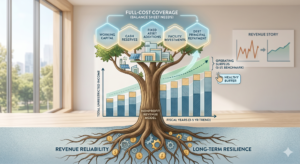
Revenue reliability doesn’t mean the same donors write the same size checks every January. It means your organization has proven, over multiple years, that it can earn or raise enough income to fund operations with reasonable certainty. That income might come from different sources in different proportions each year, but the total remains dependable.
Here’s why this matters for financing decisions: when lenders in B Generous’s nonprofit credit marketplace evaluate a loan application, revenue reliability is one of the strongest signals they look for. An organization that can demonstrate consistent unrestricted income, even if individual funding sources shift from year to year, is a far stronger borrower than one that relies heavily on a single unpredictable grant.
How to evaluate your revenue reliability:
- Compare unrestricted operating revenue across 3 to 5 years
- Identify any single funding source that accounts for more than 30% of total revenue
- Look for upward, stable, or declining trends
- Discuss context with your leadership team (e.g., a one-time dip due to a known event versus a structural decline)
Consistent Operating Surpluses
Nonprofit is a tax classification, not a financial strategy. Healthy organizations generate operating surpluses: unrestricted revenue that consistently exceeds total expenses. These surpluses aren’t excess profit sitting unused. They’re the financial cushion that allows you to weather unexpected challenges and invest in your future.
Yet the data tells a troubling story. Surveys of the nonprofit sector have consistently shown that fewer than 40% of organizations report a surplus in any given year. The remaining 60%+ are either breaking even or operating at a deficit, leaving no margin for error when something goes wrong.
Simply aiming for breakeven isn’t enough. A breakeven result means your organization has zero flexibility. One delayed grant, one unexpected repair, one insurance reimbursement held up in processing, and you’re in crisis mode. Consistent surpluses, even small ones, provide the breathing room that keeps programs running when plans change.
The Surplus Benchmark: Financial advisors typically recommend that nonprofits aim for an operating surplus of at least 3% to 5% of total revenue annually. This may sound modest, but compounded over several years, it builds meaningful reserves that protect against volatility.
Why Full-Cost Coverage Matters More Than Breakeven
Even generating consistent surpluses isn’t the complete picture. Your Income Statement captures operating revenues and expenses, but several significant cash needs don’t appear there. They live on your Balance Sheet, and ignoring them creates a slow-building financial crisis that can take years to surface.
These “full costs” of running your organization include:
- Working capital: The cash you need on hand to cover daily operations while waiting for receivables
- Cash reserves: Funds set aside for emergencies or strategic opportunities
- Fixed asset additions: Purchasing or replacing equipment, technology, and vehicles
- Facility investments: Maintenance, renovations, and capital improvements
- Debt principal repayments: The portion of loan payments that reduces your outstanding balance (interest shows on the Income Statement, but principal does not)
Setting revenue targets that cover only direct and indirect operating expenses means your organization is slowly falling behind, even when the Income Statement looks healthy. The surplus you generate needs to be large enough to also address these balance sheet obligations.
Is covering full costs every single year realistic? For most organizations, no, at least not immediately. But it’s a worthy target to work toward, and it fundamentally changes how you think about budgeting, fundraising, and financial planning.
This is also where strategic financing becomes valuable. A nonprofit line of credit, for example, can cover working capital gaps while your organization works toward full-cost coverage. Instead of dipping into reserves every time a reimbursement is delayed, you draw on your credit line and repay it when the funds arrive. Your reserves stay intact for genuine emergencies.
Balance Sheet Indicators: Liquidity, Debt, and Facility Health
While your Income Statement shows how money flows in and out over a period of time, your Balance Sheet provides a snapshot of everything your organization owns, owes, and truly controls at a specific moment. Three indicators here demand regular attention.
Liquidity: Your Organization’s Financial Oxygen
Liquidity measures your organization’s ability to cover near-term obligations with available cash or assets that can be quickly converted to cash. It’s arguably the single most important indicator of short-term financial health, because it determines whether you can actually pay staff, vendors, and program costs on time.
Financial advisors typically measure nonprofit liquidity as months of available cash relative to operating expenses. This tells you how long your organization could continue current operations if all new revenue stopped tomorrow.
Liquidity benchmarks for nonprofits:
- Fewer than 3 months: Perilously tight. Any funding delay could trigger immediate operational disruption.
- 3 to 6 months: Adequate for organizations with predictable revenue cycles, though still limited flexibility.
- 6+ months: Strong position that allows for strategic investment and risk tolerance.
Research consistently shows that more than half of nonprofits operate with three months of cash or fewer. That’s a significant vulnerability, especially for organizations that depend on government grants, insurance reimbursements, or seasonal fundraising events that can be delayed or disrupted.
Two components make up your liquidity picture:
- Available cash and cash equivalents: What’s in the bank right now, plus access to a line of credit
- Liquid Unrestricted Net Assets (LUNA): Unrestricted net assets minus illiquid items like property, equipment, and long-term investments that can’t be quickly converted
Notice that access to a credit line counts as part of your liquidity. This is one of the clearest examples of how financing directly improves a core financial health indicator. An organization with $200,000 in cash and a $500,000 credit line has significantly stronger liquidity than one with $200,000 in cash and no credit access, even though they haven’t borrowed a dime.
Debt Management: Using Financing Responsibly
Debt is a financial tool. Used well, it helps organizations manage cash flow timing, fund facility improvements, bridge revenue gaps, and make strategic investments. Used poorly, it can overwhelm an organization’s capacity to pay and jeopardize programs.

The primary metric to watch is your liabilities-to-assets ratio, which shows how much your organization owes relative to what it owns. As a general guideline, many organizations consider:
- Below 30%: Conservative and stable debt position
- 30% to 50%: Moderate. Requires active management and monitoring.
- Above 50%: Signals that liabilities are approaching or exceeding the organization’s ability to manage them, which can jeopardize program delivery
The key isn’t to avoid debt entirely. It’s to ensure that any financing you take on serves a clear purpose, has manageable repayment terms, and fits within your organization’s overall financial capacity. Bridge loans, for instance, are a short-term tool designed to be repaid quickly once committed funding arrives. They increase your liabilities temporarily but serve a specific, time-limited purpose.
Facility Stewardship: The Hidden Cost of Deferred Maintenance
If your organization owns property or significant equipment, you have a responsibility to maintain and eventually replace those assets. This is one of the most commonly overlooked areas of nonprofit financial health.
Best practice calls for maintaining a board-designated reserve fund specifically for facility improvements and replacements. In reality, few nonprofits have formal reserves for this purpose, and many rely on reactive decision-making: waiting for the roof to leak before addressing it.
Accumulated depreciation on your Balance Sheet serves as a rough accounting proxy for how much “useful life” your fixed assets have remaining. However, accounting values don’t reflect market values or actual repair costs. An independent engineer or facilities assessment provides a much more accurate picture of what future maintenance and replacement will cost.
Organizations facing significant facility needs can explore pre-development financing for early-stage planning, studies, and permits before a construction or renovation project begins. This type of financing covers the groundwork costs that must happen before a capital campaign or construction loan kicks in.
How Strategic Financing Strengthens Each Indicator
| Financial Health Indicator | The Challenge | How Financing Helps |
|---|---|---|
| Revenue Reliability | Income fluctuates between grant cycles or seasons | A line of credit smooths cash flow, so revenue timing doesn’t dictate program delivery |
| Operating Surplus | Emergency expenses erode surplus before it can accumulate | Short-term financing covers unexpected costs without depleting operating reserves |
| Full-Cost Coverage | Capital needs exceed current surplus capacity | Term loans and pre-development loans spread large costs over manageable timeframes |
| Liquidity | Cash reserves fall below safe thresholds | Access to a credit line counts as available liquidity, even when not drawn |
| Debt Management | Existing obligations crowd out operational spending | Bridge loans offer short-term, purpose-specific financing that doesn’t add permanent debt load |
| Facility Stewardship | Deferred maintenance creates growing risks and costs | Construction and facility loans fund needed upgrades with structured repayment |
Financial health indicators aren’t just diagnostic measures. They’re targets you can actively improve. One of the most direct ways to strengthen your organization’s financial position is through thoughtful, mission-aligned financing. Here’s how each indicator connects to a financing strategy:
The common thread is that financing, when chosen carefully and managed well, creates financial flexibility. It doesn’t replace sound budgeting or strong fundraising. It complements them by ensuring that cash flow timing doesn’t dictate your organization’s ability to deliver on its mission.
Matching Financial Challenges to the Right Financing Product
Not every financial challenge calls for the same solution. The nonprofit sector is extraordinarily diverse, and the financing product that works for a community health center won’t necessarily fit a charter school or a house of worship. Here’s how specific financial situations map to the financing options available through B Generous.
Cash Flow Gaps Between Grant Payments
You’ve been awarded the grant, but the disbursement won’t arrive for 60 to 90 days. Meanwhile, the program staff you hired for the grant-funded initiative need to be paid. A nonprofit line of credit provides the working capital to cover this gap, and you repay it once the grant payment posts to your account.
Waiting on Pledged Donations or Capital Campaign Commitments
Capital campaigns often generate multi-year pledges that arrive in installments. If your construction or renovation project can’t wait two years for pledge fulfillment, a bridge loan provides immediate capital against those committed future funds. The project stays on schedule, and you repay the loan as pledge payments come in.
Early-Stage Planning for New Facilities
Before a shovel hits the ground, there are architectural studies, environmental assessments, permitting fees, and engineering evaluations to fund. Pre-development financing covers these early costs so your project can move from concept to shovel-ready status without waiting for full capital to be raised.
Charter School Growth and Expansion
Charter schools face a unique financing challenge: enrollment growth creates immediate facility, staffing, and equipment needs, but per-pupil funding arrives on a lag. Charter school financing bridges this timing gap so schools can open new campuses, hire qualified teachers, and purchase curriculum materials without straining existing budgets.
Hospital and Healthcare Operating Capital
Nonprofit hospitals routinely wait 30 to 120 days for insurance reimbursements and government payments. During that waiting period, payroll, supply costs, and equipment leases don’t pause. Hospital loans provide fast access to working capital so patient care never gets interrupted by administrative payment delays.
Faith-Based Community Development

Religious organizations often need capital for building expansions, community program launches, or campus renovations, but traditional lenders may not understand the unique revenue model of tithes, offerings, and faith-based giving. Faith-based loans are specifically structured for these organizations, with terms that reflect how congregations generate and manage income.
Practical Steps to Assess Your Financial Health Today
You don’t need a CFO or an expensive consultant to start evaluating your organization’s financial health. Use this straightforward process to assess where you stand and identify areas that need attention.
Step 1: Gather Your Documents
Pull together the following for the most recent 3 to 5 fiscal years:
- Audited financial statements (or internal financials if audited statements aren’t available)
- IRS Form 990
- Annual operating budgets
- Cash flow forecasts or projections
- Board-approved strategic plan (if available)
Step 2: Calculate Your Key Metrics
Focus on the indicators outlined in this guide:
- Revenue trend: Is total unrestricted operating revenue growing, stable, or declining?
- Surplus/deficit pattern: How many of the past 5 years showed a surplus?
- Months of liquidity: Divide available cash by average monthly operating expenses
- Liabilities-to-assets ratio: Divide total liabilities by total assets
- Funding concentration risk: Does any single source account for more than 30% of revenue?
Step 3: Add Context to the Numbers
Numbers alone don’t tell the full story. A deficit in one year might be perfectly explainable (you made a planned investment in a new program). A surplus might mask a deeper problem (you deferred critical maintenance). Bring your leadership team together to discuss what the data actually means for your organization’s specific circumstances.
Step 4: Identify Gaps and Build a Plan
Where are the vulnerabilities? Maybe your liquidity is dangerously low. Maybe your facility reserve is nonexistent. Maybe your revenue is overly dependent on a single government contract. For each gap, define a concrete action:
- Low liquidity → Explore opening a nonprofit line of credit to create a financial safety net
- Facility needs → Begin a facilities assessment and explore pre-development financing
- Revenue concentration → Diversify funding sources and build a fundraising pipeline
- Grant timing issues → Consider bridge loans to decouple program delivery from payment schedules
Step 5: Share Your Financial Story
Financial health metrics aren’t just for internal use. They help your board make better governance decisions, give funders confidence in your organization’s sustainability, and demonstrate to lenders that you’re a responsible borrower. Build a brief financial narrative that covers your key indicators, explains any anomalies, and describes your plan for improvement.
Ready to Strengthen Your Nonprofit’s Financial Position?
B Generous has helped thousands of nonprofits access the capital they need to stabilize cash flow, fund growth, and protect their missions. Whether you need a line of credit, bridge loan, or specialized financing for hospitals, charter schools, or faith-based organizations, our team will help identify financing options that best fit your organization’s needs from the nation’s largest nonprofit lending marketplace.
No application fees. Personal guarantees are generally not required for nonprofit borrowers, although final requirements vary by lender and transaction. Most applications take less than 30 minutes.
Frequently Asked Questions
What is a nonprofit line of credit and how does it improve financial health?
A nonprofit line of credit is a revolving credit facility that allows organizations to draw funds as needed and repay them over time. It improves financial health by providing immediate liquidity during cash flow gaps, covering operational expenses between grant payments, and preventing mission disruptions caused by delayed revenue. Unlike a term loan, you only pay interest on the amount you actually use.
How do bridge loans help nonprofits complete capital projects on time?
Bridge loans provide short-term capital that covers expenses while an organization waits for committed funding to arrive, such as grant disbursements, pledged donations, or government reimbursements. For capital projects, this means construction timelines stay on schedule, contractors get paid on time, and the organization avoids costly delays or penalties that come with project interruptions.
What financial metrics do lenders evaluate when reviewing nonprofit loan applications?
Lenders typically evaluate several key financial metrics including revenue reliability and diversity of funding sources, operating surplus or deficit trends, months of available liquidity (cash reserves relative to operating expenses), debt-to-asset ratio, cash flow consistency, and the organization’s debt service coverage ratio. Strong performance across these metrics signals a well-managed organization that can responsibly handle additional nonprofit financing.
Can faith-based organizations and charter schools qualify for nonprofit financing?
Yes. Mission-driven lenders offer specialized financing products designed specifically for these organizations. Faith-based loans support building expansions, renovations, and new program launches. Charter school financing helps cover growth-related expenses like new campuses, staffing, and equipment. Both types of organizations can qualify as long as they are U.S.-based nonprofits in good standing with the IRS.
Disclaimer:
All examples, case studies, timelines, and cost calculations in this article are illustrative only and are not guarantees of terms, pricing, approval, or funding speed. Actual financing structures, interest rates, fees, and timelines depend on the borrower’s financial condition, documentation, collateral, and other underwriting factors. This content is provided for educational purposes and does not constitute financial, legal, or investment advice.