Nonprofit Financial Hub

How to Financially Protect the Nonprofits That Protect Us During Crises and Beyond
When natural disasters strike, when public health emergencies overwhelm communities, when economic downturns push families to the brink, it’s not Fortune 500 companies that deliver the first wave of support. It’s nonprofits. Food banks mobilize within hours. Shelters open their doors. Community health centers extend operating hours. Faith-based organizations coordinate relief efforts across neighborhoods.
Yet the organizations doing this essential work often face a painful irony: the moments when communities need them most are the exact moments when their finances are most strained. Donations slow. Government reimbursements get delayed. Grants take months to process. And costs surge.
This article examines why nonprofit financial resilience matters more than ever and how the right nonprofit financing solutions can ensure mission-driven organizations don’t just survive crises but continue to serve the people who depend on them.
The Financial Reality Nonprofits Face During Crises
During the COVID-19 pandemic, nonprofits across the United States experienced a situation that revealed a structural weakness in how the sector is funded. Schools and daycares shuttered. Supply chains broke. Demand for services like food distribution, childcare, and elder care surged overnight. Nonprofits and community-based mutual aid networks stepped up to meet those needs when no one else would.
But stepping up came at an enormous financial cost. According to survey data from across the sector, the majority of nonprofits entered crisis periods with fewer than three months of cash reserves. Many had less than 30 days of operating capital on hand. When demand spiked and revenue dropped simultaneously, organizations were forced into impossible trade-offs: cut programs, lay off staff, or take on high-cost debt that threatened long-term viability.
This isn’t just a pandemic-era problem. It’s a recurring pattern. Natural disasters, recessions, government shutdowns, and shifting funding priorities all create the same dynamic. Nonprofits absorb rising costs while waiting for funding that moves slowly through bureaucratic pipelines.
Why Traditional Funding Models Fall Short
Most nonprofits rely on a combination of grants, donations, government contracts, and earned revenue. Each of these sources carries its own timing risk:
- Grants often come with strict reporting requirements and delayed disbursements, sometimes taking 6 to 12 months from approval to receipt.
- Donations tend to be seasonal, with heavy concentration in Q4 and significant dry spells during summer months.
- Government reimbursements for services already delivered can be delayed by weeks, months, or even longer during budget impasses.
- Earned revenue from programs, events, or services drops sharply during crises when operations are disrupted.
The result is a constant tension between mission delivery and financial stability. Organizations that serve the most vulnerable populations often operate with the thinnest margins, creating a fragile system that can break under pressure.
Traditional commercial lending models are not always built around nonprofit financial structures. They require personal guarantees, rigid repayment schedules, or collateral that mission-driven organizations simply don’t have. When a food bank or community health center approaches a traditional bank during a crisis, the answer is often “no” or “not fast enough.”
Building Financial Resilience: The Case for Proactive Financing
Financial resilience isn’t about having unlimited reserves. It’s about having access to the right capital at the right time. For nonprofits, this means moving beyond a donations-only model and incorporating strategic financing tools that provide breathing room during cash flow gaps.
Think of it this way: a hospital doesn’t wait until a patient arrives to stock medical supplies. A fire department doesn’t wait for a fire to purchase equipment. Similarly, nonprofits shouldn’t wait until a financial crisis hits to explore their funding options.
Forward looking nonprofit leaders are increasingly incorporating financing solutions into their financial planning, treating access to credit as a strategic tool rather than a last resort. This approach creates stability that allows organizations to respond quickly when crises emerge and to invest in growth when opportunities arise.
Financing Options That Protect Nonprofits When It Matters Most
Not every financial challenge requires the same solution. The type of financing that works best depends on your organization’s size, cash flow patterns, and specific needs. Here’s a closer look at the tools available.
Nonprofit Lines of Credit: Your Financial Safety Net
A nonprofit line of credit is one of the most versatile financing tools available to mission-driven organizations. It works like a pre-approved pool of capital that you can draw from whenever needed, pay interest only on the amount you use, and replenish as you repay.
Lines of credit are particularly valuable for:
- Covering payroll and operating costs during slow fundraising periods
- Managing cash flow gaps between grant cycles
- Handling unexpected expenses without disrupting programs
- Pre-paying for events or program launches before revenue arrives
The key advantage is flexibility. Unlike a term loan that provides a lump sum, a line of credit gives you ongoing access that adapts to your organization’s changing needs. During stable periods, you might not draw on it at all. During a crisis, it becomes your financial lifeline.
Bridge Loans: Keeping Programs Running During Funding Delays
Funding delays are one of the most common financial stressors nonprofits face. A grant is approved but disbursement takes months. A government contract is in place but reimbursements are backlogged. A major donor has pledged a gift that won’t arrive until next quarter.
In each of these scenarios, bridge loans for nonprofits provide the short-term capital needed to keep operations running while you wait for confirmed funds. You borrow now, use the funds to maintain services, and repay once the expected income arrives.
Bridge financing is especially critical during crises when:
- Federal or state emergency funding is approved but not yet distributed
- Insurance claims are processing but your organization needs to operate immediately
- Capital campaign pledges are committed but payments are staggered over months
- Reimbursable grants require you to spend first and get paid later
Most bridge loans carry terms between 6 months and 2 years, making them a practical tool for short-term needs without long-term financial burden.
Pre-Development Funding: Preparing for What Comes Next

Crises often reveal that existing facilities and infrastructure aren’t adequate. A community health center may need to expand. A shelter may require renovations to accommodate more families. A school may need to build out new classroom space.
Before any of that construction can begin, there’s significant early-stage work that needs funding: architectural planning, environmental studies, permits, site assessments, and engineering reports. Pre-development financing covers these upfront costs so organizations can move forward with capital projects without waiting for full construction funding to materialize.
Pre-development loans are particularly important for nonprofits because traditional lenders rarely fund these early-stage expenses. Without dedicated financing, projects can stall for months or years as organizations attempt to piece together planning funds from operating budgets.
Charter School Financing: Protecting Education During Uncertain Times
Charter schools face a unique set of financial pressures. State funding is often tied to enrollment counts taken at specific points during the school year, creating cash flow gaps at the start of each academic period. Adding a crisis like a pandemic or natural disaster to this structure can be devastating.
Dedicated charter school financing helps educational organizations manage these pressures by supporting:
- Campus expansions and new facility build-outs
- Teacher and staff hiring ahead of enrollment funding
- Technology and equipment upgrades for classroom modernization
- Operating costs during delayed state disbursements
Schools that invest in financial resilience before crises hit are far better positioned to maintain educational quality, retain staff, and serve students without interruption.
Hospital Loans: Capital Access for Healthcare Providers
Nonprofit hospitals sit at the center of every community crisis. They’re the first to feel the pressure of a public health emergency and the last to receive full reimbursement for the care they provide. Medicaid and Medicare payments are notoriously slow. Insurance claim processing adds further delays. And the cost of equipment, supplies, and staffing surges during emergencies.
Hospital loans designed for nonprofit healthcare providers address these specific challenges by offering:
- Working capital loans to cover day-to-day operations during reimbursement delays
- Equipment financing for purchasing or leasing critical medical technology
- Construction and renovation loans for expanding capacity
- Lines of credit for ongoing operational flexibility
When a hospital has reliable access to capital, it can respond to emergencies faster, invest in better care, and serve more patients without the constant stress of financial uncertainty.
Faith-Based Loans: Supporting Communities of Worship and Service
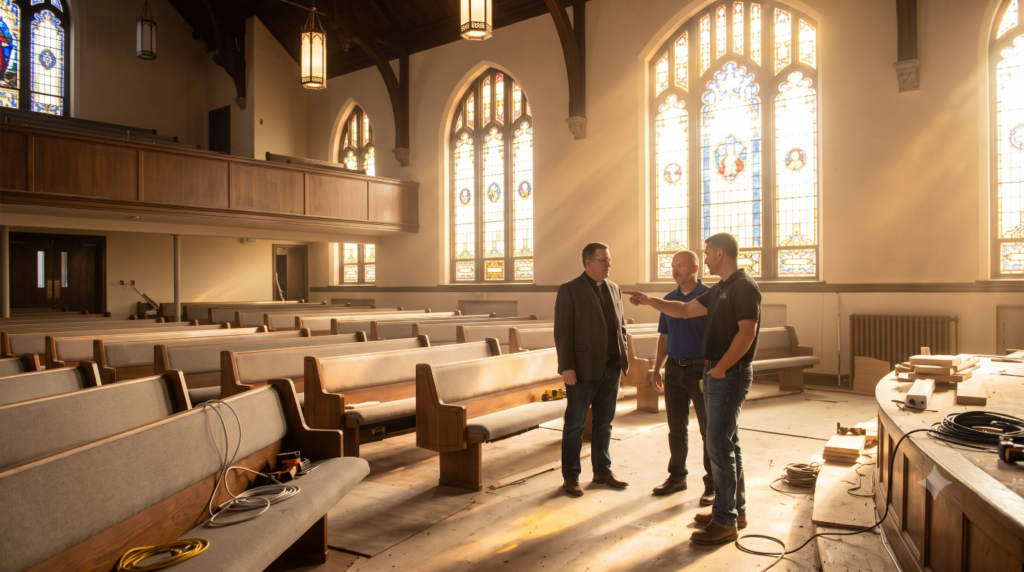
Churches, synagogues, mosques, and other houses of worship play an outsized role during crises. They open their doors as shelters, organize volunteer networks, distribute food and supplies, and provide counseling and emotional support. Yet many faith-based organizations operate on tight budgets that leave little room for the unexpected.
Faith-based loans are designed with an understanding of how religious organizations are funded and governed. Traditional lenders often struggle with the congregational model of giving, but mission-aligned lenders recognize that consistent tithing, planned giving campaigns, and community fundraising events represent reliable income streams.
These loans support everything from building renovations and new construction to program expansions and community outreach initiatives. For faith-based organizations that want to grow their impact without compromising their mission, this type of specialized financing can be transformative.
How to Choose the Right Financing Option for Your Organization
With multiple financing products available, choosing the right one depends on your organization’s specific situation. Here’s a practical framework to guide your decision:
| Your Situation | Best Financing Option | Why It Fits |
|---|---|---|
| Recurring cash flow gaps throughout the year | Nonprofit Line of Credit | Revolving access you can draw and repay repeatedly |
| Waiting on a specific grant or pledge to arrive | Bridge Loan | Short-term capital repaid when expected funds come through |
| Planning a building project or major renovation | Pre-Development Loan | Covers early-stage costs before construction financing kicks in |
| Growing a charter school or education program | Charter School Financing | Tailored to education funding cycles and expansion needs |
| Running a nonprofit hospital with reimbursement delays | Hospital Loan | Designed for healthcare cash flow and capital needs |
| Expanding a church, synagogue, or faith-based ministry | Faith-Based Loan | Mission-aligned terms built for congregational funding models |
If you’re unsure which option is right for your organization, exploring all available financing solutions is a good starting point. Many nonprofits use a combination of products to create a comprehensive financial strategy.
What the Approval Process Looks Like
One of the biggest barriers nonprofits face when seeking financing is the assumption that the process will be slow, complicated, and invasive. With mission-aligned lenders, that doesn’t have to be the case.
At B Generous, the process is designed to be straightforward:
Step 1: Submit an Online Application
Share basic information about your nonprofit, what you need funding for, and how much you’re looking to access. Most applications take less than 30 minutes to complete.
Step 2: Get Matched with the Right Solution
B Generous reviews your application and connects you with the best lending partner from the nation’s largest network of mission-aligned lenders, including banks, credit unions, CDFIs, and alternative lenders.
Step 3: Provide Documentation
Typical requirements include your IRS Form 990, recent financial statements, an operating budget, a board resolution authorizing borrowing, and cash flow projections. For bridge loans, you’ll also need documentation of the expected funds that will be used for repayment.
Step 4: Receive a Credit Review and Potential Funding Options
Many initial credit decisions are issued within approximately two weeks after complete documentation is received. If approved and final documentation is completed, funding may be available within days, depending on the lender, loan size, and complexity.
Personal guarantees are generally not required for nonprofit borrowers, though final requirements may vary by lender, loan structure, and underwriting review. Reviewing an offer does not obligate your organization to proceed.
Strengthening Your Application: What Lenders Look For
Understanding what lenders evaluate can help your organization prepare a stronger application. Key factors include:
- Annual revenue and expenses: Consistent revenue demonstrates organizational stability and repayment capacity.
- Cash flow patterns: Lenders want to see that your cash flow, while potentially uneven, follows predictable cycles.
- Diversity of funding sources: Organizations that rely on multiple revenue streams are seen as lower risk.
- Grant and donation history: A track record of receiving grants and donations signals reliability.
- Debt service coverage ratio: This measures your ability to cover loan payments from available revenue.
- Organizational leadership: Strong governance and experienced management teams give lenders confidence.
Nonprofits serving rural, underserved, or high-need communities are often given special consideration by mission-aligned lenders who prioritize social impact alongside financial returns.
Real Impact: How Financing Changes Outcomes
The difference between a nonprofit that has access to capital and one that doesn’t isn’t theoretical. It shows up in real outcomes:
- A nonprofit in New York was able to continue providing newborn care packages to low-income mothers because a structured loan covered operating costs during a funding gap.
- A Florida-based educational organization faced a massive state funding delay at the start of the school year. Access to financing saved the entire organization from shutting down.
- Healthcare nonprofits have used capital to fund the creation of heart screening centers across the country, expanding lifesaving access to communities that previously had none.
- Faith-based communities have financed renovations and construction of synagogues, churches, and youth facilities to better serve growing congregations.
In each case, timely access to financing meant the organization could continue its mission without interruption. That’s the goal: protecting the nonprofits that protect all of us.
Preparing Your Nonprofit for the Next Crisis
Financial preparation isn’t about predicting the future. It’s about ensuring your organization can respond effectively no matter what happens. Here are practical steps every nonprofit leader can take:
- Assess your current cash reserves
How many months of operating expenses can your organization cover with cash on hand? If the answer is fewer than three months, you’re operating in a vulnerable position.
- Map your funding timeline
Identify when your major revenue sources arrive throughout the year and where the gaps are. Understanding your cash flow cycles is the first step toward managing them.
- Establish a line of credit before you need it
The best time to apply for a nonprofit line of credit is when your finances are stable, not when you’re already in a cash crunch. Having pre-approved credit ready to deploy gives you immediate flexibility when the unexpected happens.
- Diversify your revenue sources
Organizations that rely too heavily on a single funder or revenue stream are most at risk during crises. Work toward a mix of grants, donations, earned revenue, and financing capacity.
- Build relationships with mission-aligned lenders
Commercial lenders rarely meet nonprofit needs during emergencies. Establishing a relationship with lenders who understand your financial model before a crisis strikes puts you in a much stronger position to act quickly when it counts.
Why Working with a Nonprofit-First Lender Matters

Not all lenders are created equal, especially when it comes to serving mission-driven organizations. A nonprofit-first lending marketplace like B Generous offers several advantages over commercial lenders:
- Understanding of nonprofit financial cycles: Mission-aligned lenders know that grants arrive in unpredictable waves and that revenue doesn’t follow a standard commercial pattern.
- Usually No personal guarantees: Board members and executive directors shouldn’t have to put personal assets on the line for organizational financing.
- Flexible terms: Repayment schedules of up to 25 years, competitive rates, and non-binding credit offers give organizations the freedom to choose what works.
- Speed: Applications can take under 30 minutes. Credit decisions are often issued within 14 business days from receipt of a completed application. If approved and final documentation is completed, funding may be available within days, depending on the lender, loan size, and complexity. Funding can be available within days of approval.
- Scale: Loans range from $25,000 to $100 million, supporting a wide range of nonprofit financing needs.
B Generous has built the largest nonprofit credit marketplace in the United States, connecting organizations with a wide range of trusted bank and nonbank lenders. Since launching the marketplace, B Generous has received over $1 billion in loan requests from more than 30,000 nonprofits and approved nearly $100 million in loans funding programs in healthcare, education, community development, faith-based services, and more.
Frequently Asked Questions
What is a nonprofit line of credit and how does it work?
A nonprofit line of credit is a pre-approved amount of revolving funding that your organization can draw from as needed. Unlike a traditional loan, you only pay interest on the amount you actually use. When you repay what you’ve drawn, that credit becomes available again. It’s ideal for managing cash flow gaps caused by delayed grants, seasonal donation cycles, or unexpected expenses. Lines of credit typically range from $100,000 to $1 million, though larger amounts are available for qualifying organizations.
How do bridge loans help nonprofits during funding delays?
Bridge loans provide short-term capital that covers operating costs while your nonprofit waits for approved grants, pledged donations, or government reimbursements to arrive. They prevent program interruptions by ensuring you have immediate access to funds during timing gaps. Once your expected funding comes through, you repay the bridge loan. Most bridge loans carry terms between 6 months and 2 years, making them a practical solution for short-term capital needs without creating long-term financial obligations.
Can faith-based organizations and churches qualify for nonprofit financing?
Yes. Faith-based organizations, including churches, synagogues, mosques, and religious nonprofits, can qualify for mission-aligned faith-based financing. These loans are structured with an understanding of how congregational giving, tithing, and planned campaigns generate revenue. They support facility expansions, new program launches, community outreach initiatives, and operational needs. To qualify, the organization must be a U.S.-based nonprofit in good standing with the IRS.
What types of financing are available for charter schools and nonprofit hospitals?
Charter schools can access financing for campus expansions, staffing, equipment purchases, technology upgrades, and operating costs during delayed state funding disbursements. Nonprofit hospitals have access to working capital loans, bridge loans for reimbursement delays, construction loans for facility development, equipment financing, and lines of credit. Loan amounts typically range from $100,000 to $100 million depending on the organization’s financial capacity and project scope.
Take the First Step Toward Financial Resilience
Nonprofits protect communities when no one else will. They deserve financial partners who understand their work and provide the tools they need to stay strong through every challenge.
Whether your organization needs a line of credit for everyday cash flow management, a bridge loan to cover a grant delay, pre-development funding for a new facility, or specialized financing for a charter school, hospital, or faith-based organization, B Generous is ready to help.
Applications are free, take less than 30 minutes, and there’s no obligation.
Or schedule a call with our team to find the right solution for your organization.
Disclaimer:
All examples, case studies, timelines, and cost calculations in this article are illustrative only and are not guarantees of terms, pricing, approval, or funding speed. Actual financing structures, interest rates, fees, and timelines depend on the borrower’s financial condition, documentation, collateral, and other underwriting factors. This content is provided for educational purposes and does not constitute financial, legal, or investment advice.