Nonprofit Financial Hub
Complete Guide to Nonprofit Financing: How to Fund Your Mission Without the Wait
Securing funding is one of the most persistent challenges facing nonprofit organizations in the United States. Whether you’re a community health center waiting on government reimbursements, a charter school planning a new campus, or a church looking to expand its outreach programs, the gap between needing money and actually receiving it can stall your entire mission.
Grants are a major funding source for many organizations, but they come with competition, compliance requirements, and often long timelines. Even when a grant is awarded, disbursement delays can leave nonprofits scrambling to cover day-to-day costs. And that’s just one piece of the funding puzzle.
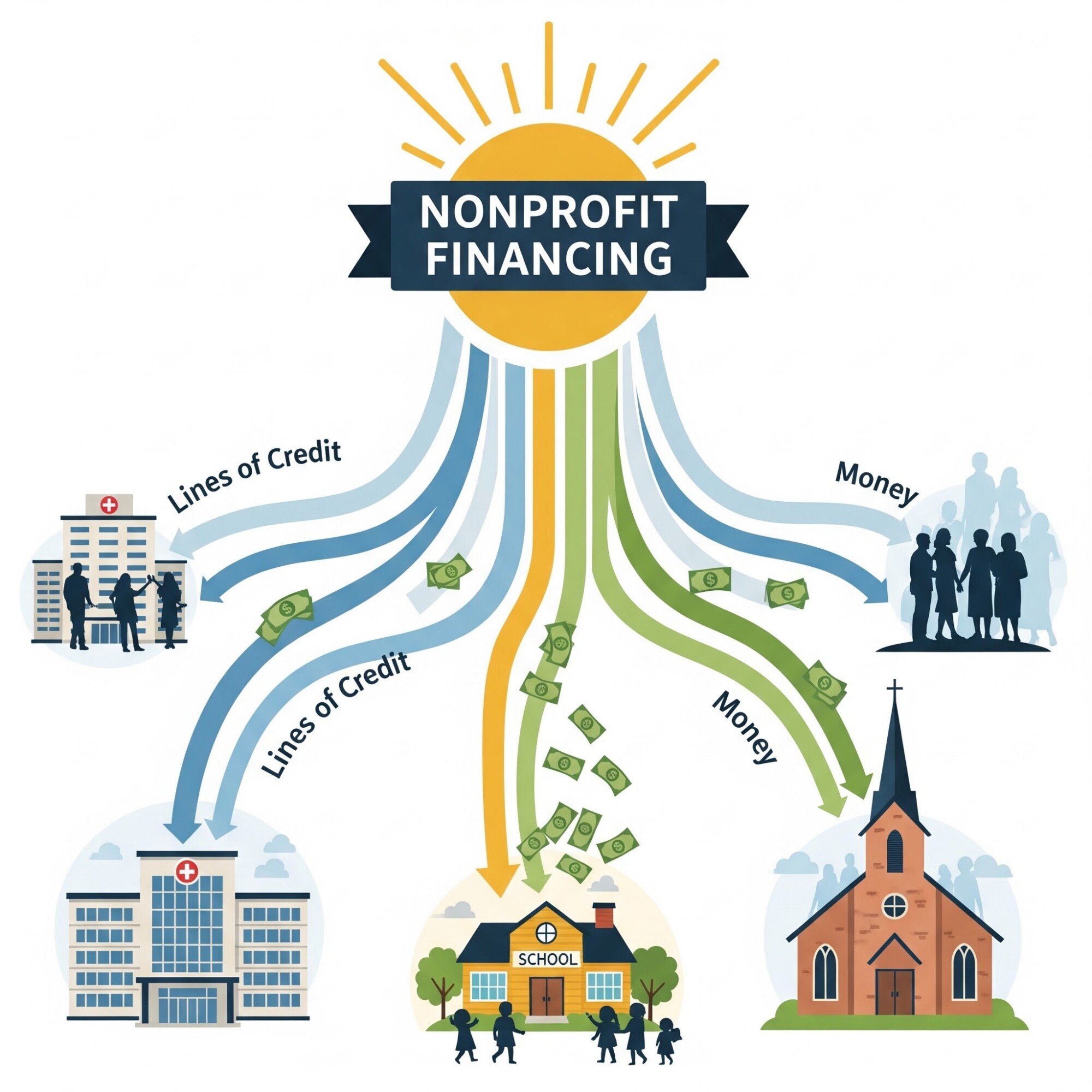
This guide covers every major nonprofit financing option available today, including lines of credit, bridge loans, pre-development funding, charter school financing, hospital capital loans, and faith-based lending. By the end, you’ll know exactly which solution fits your organization’s needs and how to get started.
Why Grants Alone Aren’t Enough for Most Nonprofits
There’s a common misconception that grants should cover everything a nonprofit needs. In reality, most nonprofits rely on a mix of funding sources: individual donations, corporate partnerships, earned revenue, government contracts, and yes, grants. But even a diversified funding model has gaps.
Here’s why relying solely on grants creates problems:
- Timing mismatches. Expenses don’t pause while you wait for a grant check. Payroll, rent, vendor contracts, and program costs happen on a fixed schedule. Grant disbursements don’t.
- Intense competition. With thousands of organizations applying for the same pools of funding, approval is never guaranteed. A single rejection can throw off an entire year’s budget.
- Restrictive use requirements. Many grants specify exactly how funds can be spent, leaving little room for general operating costs or unexpected needs.
- Reporting and compliance burdens. The administrative overhead of managing multiple grants can drain staff time and resources that could be directed toward programs.
This is where nonprofit financing steps in. Loans and credit products give your organization the flexibility to keep moving forward regardless of grant timelines. They let you act on opportunities, cover cash flow gaps, and invest in growth on your own terms.
Understanding Your Nonprofit Financing Options
Not all nonprofit loans are the same. The right financing product depends on what you need, how quickly you need it, and how you plan to repay. Here’s a breakdown of the most common options available through B Generous’s nonprofit lending marketplace.
Nonprofit Lines of Credit: Flexible, Revolving Capital
A nonprofit line of credit works like a financial safety net. You’re approved for a set amount of funding, and you draw from it whenever you need capital. You only pay interest on the amount you actually use, and as you repay, the credit becomes available again.
This makes lines of credit ideal for:
- Smoothing cash flow during slow donation periods
- Covering payroll when grant reimbursements are delayed
- Funding event preparation before sponsorship income arrives
- Handling emergency expenses without disrupting operations
- Taking advantage of vendor prepayment discounts
Most nonprofit lines of credit through B Generous range from $100,000 to $1 million, though larger amounts are available depending on your organization’s financial profile. The revolving structure means you apply once and have ongoing access to funds, rather than reapplying every time a cash flow crunch hits.
Key difference: A line of credit is revolving (draw and repay as needed), while a term loan gives you a lump sum with fixed monthly payments. Lines of credit work best for short-term, recurring cash flow needs. Term loans are better for one-time investments.
Bridge Loans for Nonprofits: Closing the Funding Gap
If your organization has confirmed funding on the way but needs capital now, a bridge loan is the solution. Bridge loans provide short-term financing to cover the gap between when expenses are due and when committed funds actually arrive.
Common scenarios where nonprofits use bridge loans include:

- Waiting on government grant disbursements that are weeks or months behind schedule
- Covering program costs while a capital campaign wraps up
- Financing expenses before long-term funding is finalized
- Managing cash flow between pledged donations and actual receipt
- Addressing delayed state reimbursements for services already delivered
Bridge loans are typically short-term, ranging from 6 months to 2 years. They’re repaid once your anticipated funding comes through. This structure keeps your programs on track and prevents the costly delays that happen when organizations are forced to pause operations.
B Generous bridge loans may be available to a wide range of nonprofit organizations, depending on financial profile, repayment source, and lender requirements.
Pre-Development Financing: Funding the Groundwork
Every building project, campus expansion, or facility renovation starts long before construction. There are feasibility studies to commission, architects to hire, permits to secure, and environmental assessments to complete. These early-stage costs are essential, but traditional lenders often view them as too risky to fund.
Pre-development financing from B Generous is built specifically for this phase. It covers costs like:
- Feasibility and market studies
- Architectural and engineering plans
- Environmental assessments and surveys
- Legal, zoning, and permitting expenses
- Site acquisition preparation
- Capital campaign planning
- Initial consultants and project staffing
Why does this matter? Because delays in pre-development can snowball. A missed permit deadline can push back an entire construction timeline. A stalled feasibility study can cause donors or government funders to lose confidence. Pre-development financing keeps your project moving so that when full capital becomes available, you’re ready to build.
Pre-development loans typically range from $250,000 to $5 million, with short-term repayment periods of 6 months to 2 years. They bridge the gap before you secure construction or permanent financing.
Charter School Financing: Capital for Education That Can’t Wait
Charter schools face a unique financial challenge. They operate with public funding but often lack the financial backing and credit history of traditional school districts. Per-pupil funding doesn’t arrive on day one. Building a new campus requires capital long before enrollment revenue starts flowing.
Charter school financing through B Generous addresses these specific challenges with funding for:
- Purchasing or expanding school facilities
- Renovating classrooms and administrative spaces
- Covering delayed state reimbursements or grants
- Investing in technology, furniture, and curriculum materials
- Launching new grade levels or additional campuses
- Managing payroll and short-term operational expenses
Lenders evaluating charter school loans look at factors like academic performance, enrollment history, leadership experience, charter renewal status, and the school’s long-term sustainability plan. Loan sizes vary from $100,000 for working capital needs to $25 million or more for major facility projects.
Schools don’t need to own their buildings to qualify. Financing is available for leased facilities, leasehold improvements, and transitions from renting to owning.
Hospital Loans for Nonprofits: Keeping Healthcare Running

Nonprofit hospitals are the backbone of healthcare in many communities, especially in rural and underserved areas. But rising operational costs, staffing shortages, aging infrastructure, and slow insurance reimbursements create constant financial pressure.
Nonprofit hospital loans from B Generous help healthcare institutions cover the costs that can’t wait for reimbursement cycles to catch up. Available funding supports:
- Facility construction, renovation, or upgrades
- Medical equipment purchases and IT systems
- Expanding services or opening new clinics
- Bridging delays in government reimbursements
- Covering operating costs during periods of growth or transition
Hospital loans are available from $100,000 for equipment or bridge needs up to $100 million for major construction or expansion projects. Lenders evaluate financial performance, payer mix (Medicare, Medicaid, and private insurance), management quality, community support, and the hospital’s strategic plan.
Small and rural hospitals are welcome. Many of the mission-aligned lenders in the B Generous network specifically serve healthcare organizations in underserved communities.
Will borrowing affect your nonprofit status?
In general, borrowing itself does not affect a nonprofit’s tax-exempt status when funds are used in support of the organization’s exempt purpose and applicable IRS rules are followed. So the answer is No. Taking on debt doesn’t impact your 501(c)(3) designation, if funds are used for charitable, operational, or mission-aligned purposes. Many of the largest nonprofit hospitals in the country use strategic debt as part of their long-term financial planning.
Faith-Based Loans: Financing That Understands Your Mission
Traditional lenders don’t always understand the financial structure of a church, synagogue, or ministry. Donation income can be seasonal. Decision-making may involve congregational votes. Cash flow from tithes and pledged gifts is inherently unpredictable.
Faith-based loans through B Generous are designed around these realities. Our lending network includes institutions that specialize in religious and mission-aligned borrowers, including Christian credit unions and lenders focused specifically on faith-based organizations.
Common uses for faith-based financing include:
- Renovating or expanding a place of worship
- Purchasing property or building new facilities
- Covering payroll and staffing costs
- Launching or sustaining youth programs and outreach
- Managing overhead while awaiting pledged gifts
- Supporting holiday services, retreats, or special campaigns
- Bridging short-term cash flow gaps tied to donation cycles
Faith-based loans range from $100,000 to $100 million, with repayment terms tailored to each organization’s giving patterns and financial capacity. Churches that don’t own their building can still qualify, especially if they’re planning to purchase property or improve leased space.
How to Choose the Right Financing Option for Your Organization
With several loan types available, picking the right one comes down to three questions:
| Financing Type | Best For | Typical Amounts | Repayment |
|---|---|---|---|
| Line of Credit | Recurring cash flow gaps, payroll, operational costs | $100K–$1M+ | Revolving; repay and reuse |
| Bridge Loan | Waiting on confirmed funding (grants, pledges, reimbursements) | $100K–$5M+ | Short-term; repaid when funds arrive |
| Pre-Development | Early-stage project costs (plans, permits, studies) | $250K–$5M+ | Short-term; 6 months–2 years |
| Charter School | Facilities, expansion, operations, equipment | $100K–$25M+ | Varies by project scope |
| Hospital Loan | Equipment, construction, operating capital, reimbursement gaps | $100K–$50M | Flexible; based on cash flow |
| Faith-Based Loan | Facility work, outreach, staffing, donation gap coverage | $100K–$50M | Tailored to giving cycles |
- What do you need the money for? A one-time capital expense (like a building project) calls for a term loan or pre-development financing. Recurring cash flow needs are better served by a line of credit.
- How soon do you need it? If you’re waiting on confirmed funding and need capital now, a bridge loan is the fastest path. Lines of credit are also quick to access once approved.
- How will you repay? Bridge loans are repaid when your expected funding arrives. Lines of credit are repaid as you use and draw funds. Term loans follow a fixed monthly schedule.
What Lenders Look for in a Nonprofit Loan Application
Understanding what lenders evaluate helps you prepare a stronger application. While requirements vary by loan type and lender, most nonprofit loan assessments include:
- Annual revenue and expenses: Lenders want to see a clear picture of your organization’s financial health. Consistent revenue, even if it fluctuates seasonally, is a positive signal.
- Cash flow consistency: How predictable is your income? Organizations with diversified funding sources (grants, donations, earned revenue) tend to fare better.
- Debt service coverage ratio: This measures your ability to repay. Lenders calculate whether your net operating income can comfortably cover loan payments.
- Organizational stability and leadership: A strong board, experienced management team, and clear strategic direction all build confidence.
- History of grants and donations: A track record of successful fundraising demonstrates reliability and community support.
- Purpose of the loan: A clear, well-documented plan for how funds will be used increases your chances of approval.
Documentation You’ll Typically Need
Most applications require:
- IRS Form 990 (most recent)
- Audited or internal financial statements
- Operating budget
- Board resolution authorizing borrowing
- Cash flow forecasts or projections
- Schedule and details of existing debt and liens
- Grant award letters or donation history (if applicable)
Specialized loans, like pre-development financing, may also require project-specific documents such as feasibility studies, architectural plans, or site surveys.
| Grants | Nonprofit Loans | |
|---|---|---|
| Cost | Free (no repayment) | Interest on borrowed amount |
| Speed | Months for approval and more for disbursement or reimbursement | Approvals in as little as 14 business days from receipt of a complete application. |
| Flexibility | Often restricted to specific uses | Flexible use depending on loan type |
| Predictability | Competitive; no guarantee of approval | Based on your financials; more predictable |
| Availability | Limited cycles and deadlines | Available year-round |
| Best for | Program-specific funding, capital campaigns | Cash flow, operations, bridge needs, growth |
Grants vs. Loans: When Each Makes Sense
Grants and loans aren’t competing options. They’re complementary tools that serve different purposes in your funding strategy.
The strongest nonprofit financial strategy uses both. Pursue grants for program-specific initiatives and capital campaigns, and use flexible loan solutions to keep operations steady while those grants are being processed.
How B Generous Makes Nonprofit Financing Simple
B Generous built the largest nonprofit credit marketplace in the United States. By connecting nonprofits to a wide network of mission-aligned bank and nonbank lenders, the platform gives organizations access to competitive rates and terms specifically designed for the nonprofit sector.
Here’s how the process works:
1. Tell Us About Your Organization
Start with a quick online application. Share basic information about your nonprofit, what you need funding for, and how much you’re looking to access. The application takes less than 30 minutes, and there are no fees to apply.
2. Get Matched With the Right Solution
The B Generous team reviews your goals and connects you with the financing option that fits best, whether that’s a flexible line of credit, a short-term bridge loan, a term loan, or something custom-built for your situation.
3. Receive a Credit Review and Potential Funding Options
Many initial credit decisions are issued within two weeks of receiving all documents. Once fully approved by a lender, funds are typically available within a few business days of signing the closing documents. For many loans no personal guarantees are required.
Who Qualifies for Nonprofit Financing?
B Generous provides financing to all types of U.S.-based nonprofit organizations, including 501(c)(3), 501(c)(4), and other tax-exempt entities. This includes:
- Human services and social welfare organizations
- Schools, universities, and education foundations
- Hospitals and healthcare providers
- Churches, synagogues, ministries, and faith-based groups
- Arts and cultural institutions
- Environmental and advocacy organizations
- Animal welfare nonprofits
- Youth development and community organizations
To qualify, your nonprofit must be headquartered in one of the 50 U.S. states, maintain a U.S. bank account, and maintain active tax-exempt status with the IRS. International operations are welcome, if your main office is in the United States.
Loan amounts typically range from $25,000 to $100 million, with repayment terms up to 25 years depending on the financing product.
5 Signs Your Nonprofit Is Ready to Borrow
Taking on debt is a strategic decision. Here are the indicators that financing could be the right move for your organization:
- You have a clear, documented plan for the funds. Whether it’s a building project, equipment purchase, or cash flow stabilization, you know exactly what the money is for and can articulate why it matters.
- You can demonstrate reliable revenue. Consistent grant funding, donation history, or earned income gives lenders confidence that you can make repayments.
- You understand the repayment obligations. You’ve reviewed your cash flow projections and know how monthly payments fit into your budget.
- Timing is costing you money or opportunity. If delayed funding is causing you to miss deadlines, lose staff, or postpone programs, the cost of waiting may exceed the cost of borrowing.
- You’ve explored grant options but need faster or more flexible capital. Grants and loans work best together. If grants alone can’t cover your timeline, financing fills the gap.
Frequently Asked Questions About Nonprofit Financing
What is a nonprofit line of credit and how does it work?
A nonprofit line of credit is a pre-approved amount of revolving funding your organization can draw from as needed. Unlike a traditional term loan, you only pay interest on the amount you actually use. When you repay what you’ve drawn, that credit becomes available again. It’s ideal for managing cash flow gaps, covering payroll during slow donation periods, or bridging delays in grant disbursements. B Generous offers nonprofit lines of credit from $100,000 to $1 million or more, with competitive rates through its nationwide network of mission-aligned lenders.
How do bridge loans help nonprofits with capital projects?
Bridge loans provide short-term capital to nonprofits that have secured funding commitments but haven’t received the cash yet. For capital projects, this means you can begin construction, hire contractors, purchase equipment, or cover operating expenses while waiting on government grants, donor pledges, or reimbursements. Bridge loans typically range from 6 months to 2 years and are repaid once the committed funds arrive. They prevent costly project delays and help nonprofits maintain momentum on critical initiatives.
Can faith-based organizations like churches qualify for nonprofit loans?
Yes. Churches, synagogues, ministries, religious schools, and other faith-based organizations can qualify for nonprofit loans. Most lenders require some form of tax-exempt status, such as 501(c)(3) recognition, though some lenders also work with churches automatically recognized by the IRS as tax-exempt. Faith-based loans are structured to accommodate irregular cash flow from donations or tithes, congregational decision-making, and mission-driven priorities. B Generous connects faith-based organizations to lenders who understand these unique financial structures.
What documentation do nonprofits need to apply for financing?
Most nonprofit lenders require: IRS Form 990, recent audited or internal financial statements, an operating budget, a board resolution authorizing borrowing, cash flow forecasts or projections, a schedule of existing debt and liens, and grant award letters or donation history. Some loan types, like pre-development financing, may also require project-specific documents such as feasibility studies, architectural plans, or site surveys. The B Generous application takes less than 30 minutes to complete, and there are no application fees.
Ready to Fund Your Mission?
Whether you need a line of credit to manage cash flow, a bridge loan to keep projects on schedule, or specialized financing for your school, hospital, or house of worship, B Generous is here to help.
Applying is free, takes less than 30 minutes, and for most loans no personal guarantees are requested. Most initial credit decisions are issued within two weeks of receipt of a completed application package.
Disclaimer:
All examples, case studies, timelines, and cost calculations in this article are illustrative only and are not guarantees of terms, pricing, approval, or funding speed. Actual financing structures, interest rates, fees, and timelines depend on the borrower’s financial condition, documentation, collateral, and other underwriting factors. This content is provided for educational purposes and does not constitute financial, legal, or investment advice.