Nonprofit Financial Hub

6 Ways Nonprofits Can Take Financial Action During Economic Uncertainty
When funding gets unpredictable, your mission doesn’t have to stall. Here are practical financing strategies that help nonprofits stay resilient, protect their teams, and keep serving communities.
Anyone who’s ever managed a nonprofit budget knows the feeling: you’ve got committed funding on paper, but the cash hasn’t hit your account. Now multiply that tension by rising inflation, shifting government priorities, and donors tightening their own belts.
Economic uncertainty isn’t new for nonprofits. But the scale and speed of recent disruptions have made it clear that organizations need more than good intentions to survive. They need a financial game plan.
The good news? You don’t have to sit and wait for conditions to improve. Whether you’re leading a community health center, running a charter school, or managing a faith-based ministry, there are concrete steps you can take right now to strengthen your financial position and protect your mission.
At B Generous, we’ve worked with thousands of nonprofits navigating exactly these challenges. Here are six actions that can help your organization stay steady when the economy isn’t.
- Assess Your Financial Position Honestly
Before you can solve a problem, you need to understand it. And for many nonprofits, that means taking a hard look at where things actually stand, not where you hoped they’d be by now.
Start with the basics:
- Cash flow analysis: How many months of operating expenses can you cover with what’s in the bank today? If the answer is less than three, that’s a red flag worth addressing.
- Revenue diversity: Are you dependent on one or two major funders? Organizations with diversified income streams (earned revenue, individual donors, grants, government contracts) tend to weather downturns more effectively.
- Expense flexibility: Which costs are fixed and which can be adjusted? Knowing this helps you respond quickly if revenue dips.
This kind of assessment isn’t just about finding problems. It’s about identifying strengths you might be undervaluing. Community trust, strong donor relationships, experienced staff, and program impact are real assets, even if they don’t show up on a balance sheet.
Quick Tip: Build Multiple Budget Scenarios
Don’t rely on a single budget projection. Create at least three scenarios: optimistic, moderate, and conservative. Account for variables like continued inflation, late government payments, and declining philanthropic support. This gives your board and leadership team a realistic range of outcomes to plan around.
If your assessment reveals that current challenges are temporary (a delayed grant payment, a seasonal fundraising lull), a short-term financing solution like a bridge loan or nonprofit line of credit can provide the stability you need without long-term debt commitments.
If the challenges are more fundamental, like a permanent loss of a major funder or a structural deficit, you may need to rethink your business model. Either way, the assessment is what gives you clarity.
- Secure Flexible Financing Before You Need It
Here’s something many nonprofit leaders learn the hard way: the best time to secure financing is before the crisis hits.
Think of it like insurance. You don’t buy it when the building’s on fire. Having a line of credit in place means you can draw funds the moment a cash flow gap appears, without scrambling through a weeks-long application process while bills pile up.
Why a Line of Credit Makes Sense for Nonprofits
A nonprofit line of credit is revolving funding that, once approved, can be drawn as needed up to the available credit limit. You only pay interest on what you actually draw, and as you repay, that credit becomes available again. It’s built for the kind of unpredictable funding cycles nonprofits deal with every day.
Common uses include:
- Covering payroll when grant disbursements are delayed
- Smoothing out seasonal fundraising dips
- Pre-paying vendors to capture early-payment discounts
- Funding emergency repairs or unexpected expenses
Bridge Loans: When You Know the Money’s Coming
If your organization has approved funding that simply hasn’t arrived yet, a bridge loan for nonprofits is the right tool. It provides short-term capital to cover immediate needs while you wait for grants, donations, or government reimbursements to come through.
This is especially valuable for organizations dealing with:
- Government contracts with 60- to 90-day or longer payment cycles
- Capital campaigns where pledges are committed but not yet collected
- Construction projects where funding is staged or phased
The key difference between a line of credit and a bridge loan? A line of credit is ongoing and revolving. A bridge loan is tied to a specific funding gap with a clear repayment source. Both can be essential tools in your financial toolkit.
- Plan Capital Projects Strategically with Pre-Development Funding
Economic uncertainty doesn’t mean hitting pause on growth. Sometimes, the smartest move is to keep planning, because the organizations that are ready when conditions improve are the ones that thrive.
But there’s a catch: the early stages of any capital project (feasibility studies, architectural plans, permitting, environmental assessments) cost real money. And traditional lenders often won’t fund these pre-construction expenses because they see them as too risky.
That’s exactly what pre-development financing is designed to solve.
What Pre-Development Loans Cover
- Feasibility and environmental studies
- Architectural and engineering plans
- Legal, zoning, and permitting fees
- Site acquisition preparation
- Capital campaign planning
- Community needs assessments
Why This Matters Right Now
We’ve seen nonprofits delay pre-development work during downturns, only to miss critical funding windows or lose stakeholder momentum. When you invest in the planning phase, you’re positioning your organization to move fast when conditions align. That credibility matters to donors, city officials, and future lenders.
Pre-development loans are typically short-term (6 months to 2 years) and structured to bridge the gap before construction or permanent financing kicks in. It’s a calculated investment, not a gamble.
- Communicate Transparently with Stakeholders
When the economy gets rocky, one of the most powerful things a nonprofit leader can do is talk about it openly, with funders, with staff, and with the communities you serve.
With Grant Makers and Donors
Power dynamics can make these conversations uncomfortable. But here’s what we consistently hear from funders: they’d rather get an honest update than be surprised by a crisis later.
Consider sharing:
- Your community impact: Remind funders of the essential role you play, especially when people are struggling most.
- Your role as an employer: Nonprofits are economic engines. You’re paying living wages, providing benefits, and keeping money moving in local economies.
- What you actually need: Whether it’s funding to cover true costs, more flexibility with reporting, or additional support to adjust for inflation, be specific.
Early communication builds trust. It positions you as a thoughtful, proactive leader rather than someone reacting to a crisis they didn’t see coming.
With Your Team
Staff members are a nonprofit’s most valuable asset. And in a tight labor market, retaining good people matters more than ever. According to recent surveys, more than half of nonprofits are struggling to fill positions, and nearly 80% are actively trying to close staffing gaps.

If you can share measures of stability (salaries funded through the year, secured contracts, a healthy cash reserve), do it. That kind of transparency reduces anxiety and strengthens loyalty.
And if cash is tight? There are still ways to show your team they matter: flexible work arrangements, additional time off, staff meals, and professional development opportunities. These are meaningful investments that don’t always require large budgets.
- Pursue Financing Tailored to Your Sector
Not all nonprofits face the same financial challenges. A charter school navigating per-pupil funding delays has different needs than a hospital managing Medicare reimbursements or a church bridging a capital campaign gap.
That’s why sector-specific financing matters. Generic loan products from traditional banks often miss the nuances of how mission-driven organizations actually operate.
Charter School Financing
Charter schools often run on thin margins with irregular state payments and capital-intensive facility needs. Charter school financing is structured to account for these realities, covering everything from new campus buildouts to bridge loans for delayed state reimbursements.
Loan types available to charter schools include:
- Facility loans for purchasing, building, or renovating school buildings
- Working capital loans for payroll and operating expenses
- Bridge loans to manage cash flow during funding delays
- Pre-development loans for planning and site acquisition
Hospital Loans for Nonprofits
Nonprofit hospitals face a unique squeeze: rising costs, staffing shortages, and slow reimbursements. Hospital financing through B Generous may help nonprofit healthcare providers access working capital, equipment financing, construction financing, or lines of credit, depending on lender criteria and underwriting review. Personal guarantees are generally not required for nonprofit borrowers, though final requirements may vary by lender and loan structure.
Whether you’re a large metropolitan health system or a small rural hospital, mission-aligned lenders in our network understand healthcare-specific challenges like payer mix complexity and government reimbursement timelines.
Faith-Based Organization Loans
Churches, synagogues, ministries, and religious schools have financial patterns that traditional banks sometimes struggle with. Donation-dependent cash flow, congregational decision-making, and seasonal giving cycles all affect how and when funds arrive.
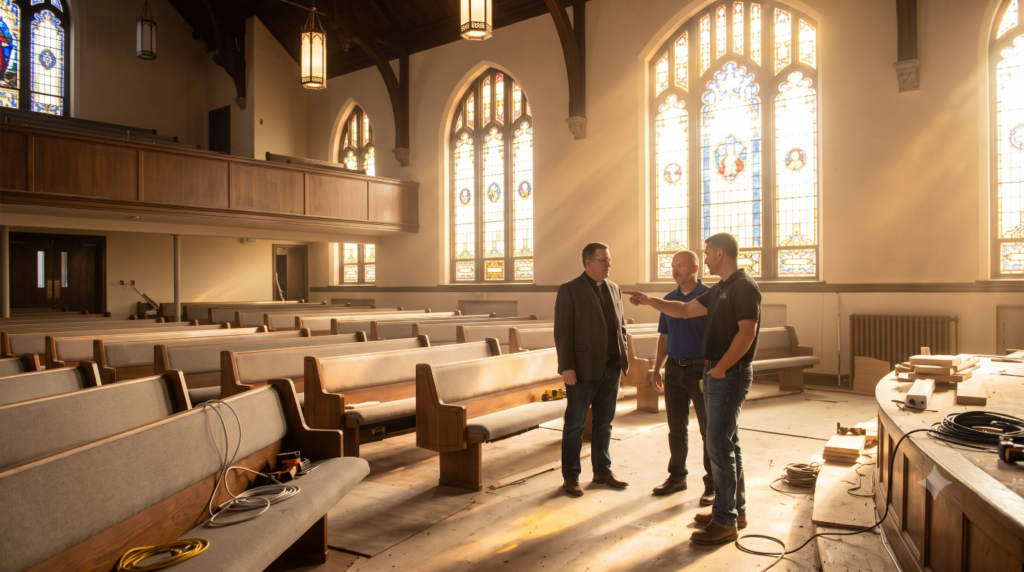
Faith-based loans are structured to work with these realities, not against them. Whether you need to renovate a worship space, launch a new outreach program, or bridge a gap between pledges and cash-in-hand, there are lenders who understand your mission and your model.
- Collaborate, Coordinate, and Advocate Together
Here’s something that’s easy to overlook when you’re focused on your own organization’s survival: you’re not in this alone. And the nonprofits that weather economic uncertainty best are often the ones that work together.
Peer Coordination
Collaboration takes time, but it can amplify your impact in ways that individual efforts can’t. Consider:
- Joint advocacy: Partner with peer organizations to petition for better government reimbursement rates, timely payments, or more inclusive contracting processes.
- Shared services: Back-office functions like HR, accounting, and IT can sometimes be shared among smaller nonprofits to reduce costs.
- Collective bargaining: Groups of organizations serving similar communities can present a unified case to funders about the true cost of service delivery.
Advancing Equity in Financing Access
It’s important to recognize that economic downturns hit communities of color disproportionately, and BIPOC-led nonprofits have historically had less access to capital and financial resources.
Well-resourced organizations can help by:
- Amplifying the work of BIPOC-led organizations in their communities
- Making introductions to funders and financial institutions
- Advocating for equitable government planning and contracting
- Declining or redirecting unsolicited emergency funds to smaller organizations with greater need
Equitable access to nonprofit financing isn’t just good ethics. It’s good practice. When more organizations can access the capital they need, entire communities become more resilient.
Choosing the Right Financing: A Quick Comparison
With several financing options available, it helps to understand which tool fits which situation. Here’s a side-by-side look:
| Financing Type | Best For | Typical Term | Key Feature |
|---|---|---|---|
| Line of Credit | Ongoing cash flow management | Revolving (annual renewal) | Draw and repay as needed; pay interest only on what you use |
| Bridge Loan | Waiting on approved funding | 6 months – 2 years | Short-term capital tied to a specific incoming payment |
| Pre-Development Loan | Early-stage project planning | 6 months – 2 years | Covers feasibility, permits, and design before construction |
| Charter School Financing | School operations and expansion | Varies by loan type | Structured around per-pupil funding and school calendars |
| Hospital Loans | Healthcare operations and infrastructure | Varies by loan type | Usually no personal guarantees; accounts for reimbursement cycles |
| Faith-Based Loans | Religious organizations and ministries | Varies by loan type | Aligns with donation cycles and congregational governance |
Why Financial Stability Matters More Than Growth Right Now
There’s a persistent assumption in the nonprofit world that growth equals success. More programs, more staff, a bigger building. But in uncertain economic times, stability is often the smarter goal.
Investing in things that make your organization stronger without necessarily making it bigger can pay enormous dividends:
- Staff retention: Keeping experienced people saves recruitment costs and preserves institutional knowledge.
- Financial reserves: Even a modest cash reserve (two to three months of operating expenses) can be the difference between weathering a disruption and shutting down a program.
- Systems and infrastructure: Better financial management tools, updated donor databases, and streamlined operations make you more efficient and more attractive to funders.
Growth will come when the timing is right. Right now, the priority is making sure your organization is built to last.
Frequently Asked Questions
What is a nonprofit line of credit and how does it help during economic uncertainty?
A nonprofit line of credit is a pre-approved amount of revolving funding your organization can draw from as needed. During economic uncertainty, it provides a financial safety net that lets you cover cash flow gaps, manage delayed grants, and fund day-to-day operations without reapplying for a new loan each time. You only pay interest on what you use, making it a cost-effective way to maintain stability.
How can bridge loans help nonprofits manage capital project delays?
Bridge loans provide short-term capital to cover immediate expenses while your organization waits for approved funding (like government grants, pledged donations, or reimbursements) to arrive. For capital projects, this means you can keep construction on schedule, pay contractors on time, and avoid costly delays that compound when timelines slip. Bridge loans are typically repaid once the expected funds come through.
What financing options are available for charter schools and faith-based organizations?
Charter schools can access facility loans, working capital loans, bridge loans for delayed state reimbursements, and pre-development financing for new campuses. Faith-based organizations like churches, synagogues, and ministries can qualify for real estate loans, construction and renovation loans, working capital loans, bridge loans, and lines of credit. B Generous connects both types of organizations to mission-aligned lenders who understand their unique funding cycles.
How quickly can a nonprofit get approved for emergency financing?
At B Generous, most preliminary credit decisions are issued within 2 weeks of receiving all required documents, with funding for fully approved and underwritten loans available within days after that stage. Speed depends on the loan type, complexity, and how quickly your organization can provide documentation like IRS Form 990, financial statements, and cash flow projections.
Your Mission Doesn’t Pause for the Economy
Economic uncertainty is real, but it doesn’t have to define your organization’s future. Whether you need a line of credit to smooth out cash flow, a bridge loan to cover a funding gap, or specialty financing for a school, hospital, or faith-based ministry, B Generous connects you to the right solution, fast.
We’ve built the nation’s largest nonprofit credit marketplace because we believe mission-driven organizations deserve better access to capital. No upfront costs. Applications that take minutes, not weeks. And a team that understands how nonprofits work.
Disclaimer:
All examples, case studies, timelines, and cost calculations in this article are illustrative only and are not guarantees of terms, pricing, approval, or funding speed. Actual financing structures, interest rates, fees, and timelines depend on the borrower’s financial condition, documentation, collateral, and other underwriting factors. This content is provided for educational purposes and does not constitute financial, legal, or investment advice.